Tempus AI: Building the Operating System for Precision Oncology — Why It Outpaces Guardant Health and Caris Life Sciences
June 2026

I’ve been getting a lot of questions on competition so I thought I would do a dedicated post on it. This isn’t financial advice and I do have a position in $TEM.
Precision oncology sits at a remarkable inflection point. In my view, the vision of truly personalized cancer care of matching the right therapy to the right patient at the right time has moved well beyond theory and is now being actively built. Companies that combine genomics, expansive datasets, and artificial intelligence are leading this shift. Among them, Tempus AI stands out to me not merely as another testing company, but as the emerging operating system for the entire field.
In this article, I share my detailed comparison of Tempus against its two most relevant peers: Guardant Health (GH), the liquid biopsy company that many see as the closest pure play competitor in diagnostics and data, and Caris Life Sciences (CAI), a strong specialist in comprehensive molecular profiling. Each brings real strengths, but I believe Tempus possesses the broadest moat, the most scalable business model, and the clearest path to long term leadership.
I will begin with a quote from Eric that explains exactly why Tempus has the edge:
“And it’s the same thing with Tempus. We have a technological advantage over our competitors. It’s not that you can’t get a perfectly good result from somebody else that’s sequencing, you can, you can order a test and if you’re just looking for the top 100 genes that might be mutated you can order a Foundation One test and they’ll deliver you those results. You can order Caris or Guardant and whatever, they’re all 100% perfectly fine.
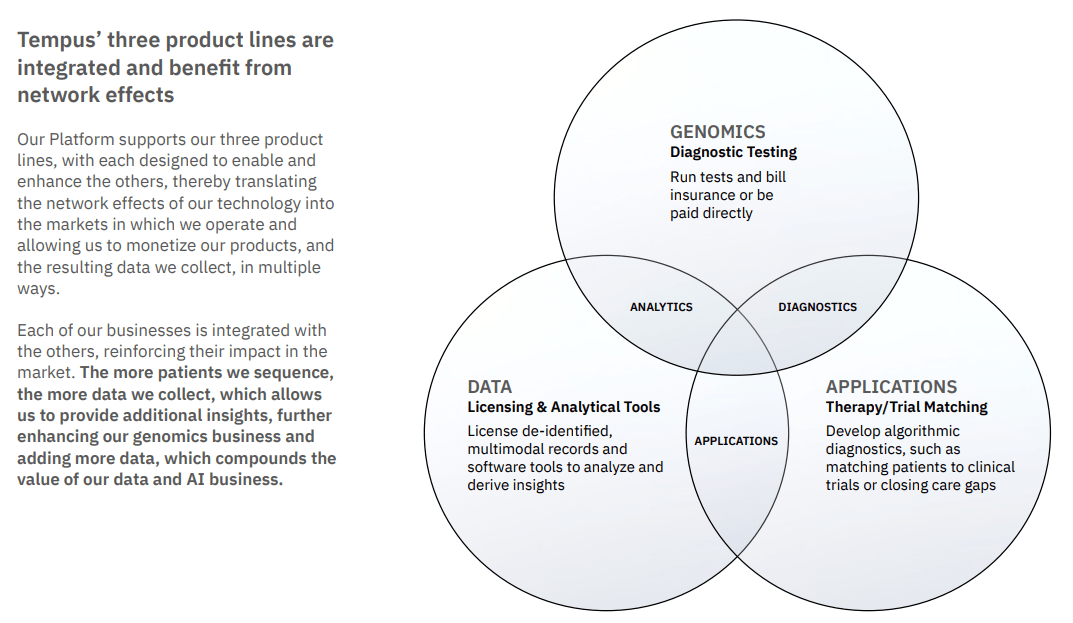
But we have a lot of technology that is wrapped around our tests. How we’re integrated with electronic healthcare record systems, how we personalise these tests by matching them to clinical data. Other insights that we can derive that other people just can’t because of how much money we’ve invested in all these algorithmic diagnostics that sit on top. Our ability to route patients to the right clinical trial, our ability to close care gaps. There’s a lot of technology.
And so, I think for physicians who choose us over other people, and clearly doctors have chosen Tempus over others over the last… we’ve become the largest sequencer. So we’ve grown much faster than our competition… So more and more physicians have migrated to Tempus because of that technology and that edge.”
Tempus Is not “Just Another Liquid Biopsy Company”
I have tremendous respect for what Guardant Health has accomplished. It pioneered commercial liquid biopsy with Guardant360 CDx, expanded into therapy selection and monitoring, and more recently launched Shield for colorectal cancer screening. The company continues to post impressive test volumes, secure key FDA approvals, and deliver strong revenue growth. In the first quarter of 2026, Guardant reported $301.7 million in revenue, up 48% YoY and raised its full year guidance to between $1.30 and $1.32 billion.
That said, I see Guardant at its core as a highly accomplished diagnostics laboratory. Its economics remain closely tied to test reimbursement and volume growth in a primarily single modality (liquid biopsy) world. While biopharma partnerships and data offerings exist, they have not yet evolved into the high margin, platform style revenue that I consider essential for true operating system status.
By contrast, Tempus was intentionally designed from day one as a data first, AI powered platform. In my opinion, it now stewards what is arguably the world’s largest multimodal oncology dataset that is seamlessly integrating genomics, transcriptomics, imaging, electronic health records, and real world outcomes. This foundation powers a rapidly expanding, high margin second business of data licensing and AI applications sold to pharmaceutical leaders through multi year deals that accelerate drug development and biomarker discovery.
The financial picture reinforces my view. Tempus delivered $348.1 million in Q1 2026 revenue (up 36% YoY) and raised full year guidance to $1.59–1.60 billion while targeting about $65 million in adjusted EBITDA. Guardant, despite solid momentum, continues to report meaningful net losses and cash burn. Tempus is also investing in their platform and burning cash but is making stronger progress when backing out one offs especially for Q1. Although gross margins are comparable today, I am particularly encouraged by how Tempus is steadily shifting its revenue mix toward higher margin data and applications, which have been growing north of 40% in recent quarters.
Even with this more diversified profile and clearer profitability path, Tempus currently trades at roughly half Guardant’s market capitalization on stronger revenue guidance. I suspect many investors still bucket Tempus primarily as a liquid biopsy play rather than recognizing the growing platform economics.
Tempus vs. Caris Life Sciences: Breadth and Integration versus Depth and Focus
I also hold Caris Life Sciences in high regard. The company has built genuine leadership in comprehensive molecular profiling, offering deep per patient insights through whole exome sequencing, whole transcriptome sequencing, and proteomics. Its ACHIEVE-1 data for the Caris Detect multi cancer early detection test delivered promising early stage results, reflecting a smart focus on longitudinal, outcome linked datasets.
Operationally, Caris impresses me with its discipline. It achieved positive free cash flow in Q1 2026 and guides to $1.0–1.02 billion in full year revenue with continued growth. Its emphasis on deeper profiling per sample serves certain advanced disease and research use cases particularly well.
However, from my perspective, Caris functions more as a specialized molecular intelligence provider. Its institutional reach and cumulative multimodal dataset breadth lag behind Tempus, and it does not yet match the same level of real time electronic health record integration and workflow embedding. Tempus benefits from a powerful flywheel that I find hard to replicate elsewhere. The broader testing and deeper integrations generate richer data, which improves AI tools, attracts more pharma partners, and funds further expansion. In short, I see Caris excelling in targeted depth and near term profitability, while Tempus wins on scale, connectivity, and long term ecosystem leverage.
Why Tempus Wins: The Operating System Advantage
The architectural difference is what ultimately convinces me. Guardant has built an excellent diagnostic suite now extending into screening, and Caris has developed deep profiling expertise with promising early detection ambitions. Tempus, however, is assembling the broader platform that can support and enhance both and far more.
Its multimodal dataset is not only large but actively linked across modalities and embedded in daily clinical workflows. This creates compounding network effects that narrower solutions struggle to match. Diagnostics provide the volume and entry point, but I believe the real differentiation comes from the data licensing and AI applications layer, which delivers superior margins and sticky, long term contracts with pharmaceutical companies.
I am also impressed by Tempus’s substantial investments in infrastructure, including significant GPU capacity that allows partners to train and refine custom models directly on its harmonized datasets. This capability, in my opinion, accelerates discovery in ways more constrained databases cannot easily equal. The result is a hybrid model where testing volumes grow steadily while the platform layer compounds even faster.
Even in multi cancer early detection, Tempus holds natural optionality. Its closed loop system and unmatched scale give it flexibility to expand into population level tools when the clinical and regulatory environment matures, all while maintaining strength in the full post diagnosis ecosystem.
Risks Worth Acknowledging
Of course, I recognize the risks. Tempus must execute well on platform scaling amid cash flow dynamics, stock based compensation, and ongoing intellectual property matters with Guardant. Reimbursement shifts, AI regulatory scrutiny, and competition from incumbents or newcomers could create hurdles. Market education on the platform distinction will take time, and volatility remains part of the story unfortunately.
Still, I believe the structural advantages including a massive, growing, real world multimodal dataset with proven monetization paths are becoming increasingly durable. If data integration and artificial intelligence define the next decade of oncology, Tempus sits squarely at the center.
Final Thoughts
Guardant Health has earned its pioneering status in liquid biopsy and clinical leadership. Caris Life Sciences has constructed a profitable, high quality business centered on molecular depth and screening potential. Both are capable competitors in their lanes.
Tempus AI, however, is methodically building something more comprehensive in my view: the connective data operating system that spans diagnostics, accelerates research, improves care delivery, and drives better outcomes at scale. Its current valuation, which appears to undervalue this platform transition relative to peers, strikes me as an attractive opportunity for long term investors who share conviction in multimodal data and AI as the future of precision medicine.
The operational and strategic gap continues to widen in Tempus’s favor. Over time, I expect the market’s perception and valuation to catch up.
Not financial advice. Please do your own thorough research and consider your personal risk tolerance. Company and market conditions evolve; this reflects information available as of mid June 2026 and things change.